









82.51×63 is a straightforward multiplication problem involving a decimal number and a whole number. At first glance, the decimal point can make the calculation look slightly more complicated than ordinary multiplication, but the process is simple once you break it into smaller parts. The easiest approach is to multiply 82.51 by 63 using standard long multiplication, or split 63 into 60 and 3 and solve the two smaller calculations separately. Both methods give the same result: 82.51 × 63 = 5,198.13. Understanding why the decimal appears where it does is just as important as getting the final number right, especially when working with measurements, prices, percentages, or other real-world calculations.
What Is 82.51 × 63?
The expression 82.51 × 63 asks you to multiply 82.51 by 63. Here, 82.51 is the decimal factor and 63 is the whole-number factor. Multiplication means adding the same quantity repeatedly, so multiplying 82.51 by 63 is equivalent to adding 82.51 to itself 63 times. Of course, writing out 63 additions would be unnecessarily long, which is why multiplication provides a much faster method. The important thing to remember is that the decimal point in 82.51 must be handled correctly throughout the calculation.
What Is the Answer to 82.51×63?
The answer to 82.51 × 63 is 5,198.13. This can be confirmed using more than one method. You can use traditional long multiplication, break 63 into 60 and 3, or temporarily remove the decimal point and restore it after multiplying. When each method produces 5,198.13, you can be confident that the calculation is correct.
Step 1: Write the Calculation Clearly
Start by writing the multiplication in a clear format. Place 82.51 above 63 and align the numbers properly. Because 63 is a whole number, it does not have a decimal portion, so there is no need to add unnecessary zeros. The setup can be viewed as 82.51 multiplied by 63. Keeping the numbers organized is especially helpful when performing the calculation by hand because it reduces the chance of placing a digit in the wrong position.
Step 2: Break 63 Into Smaller Parts
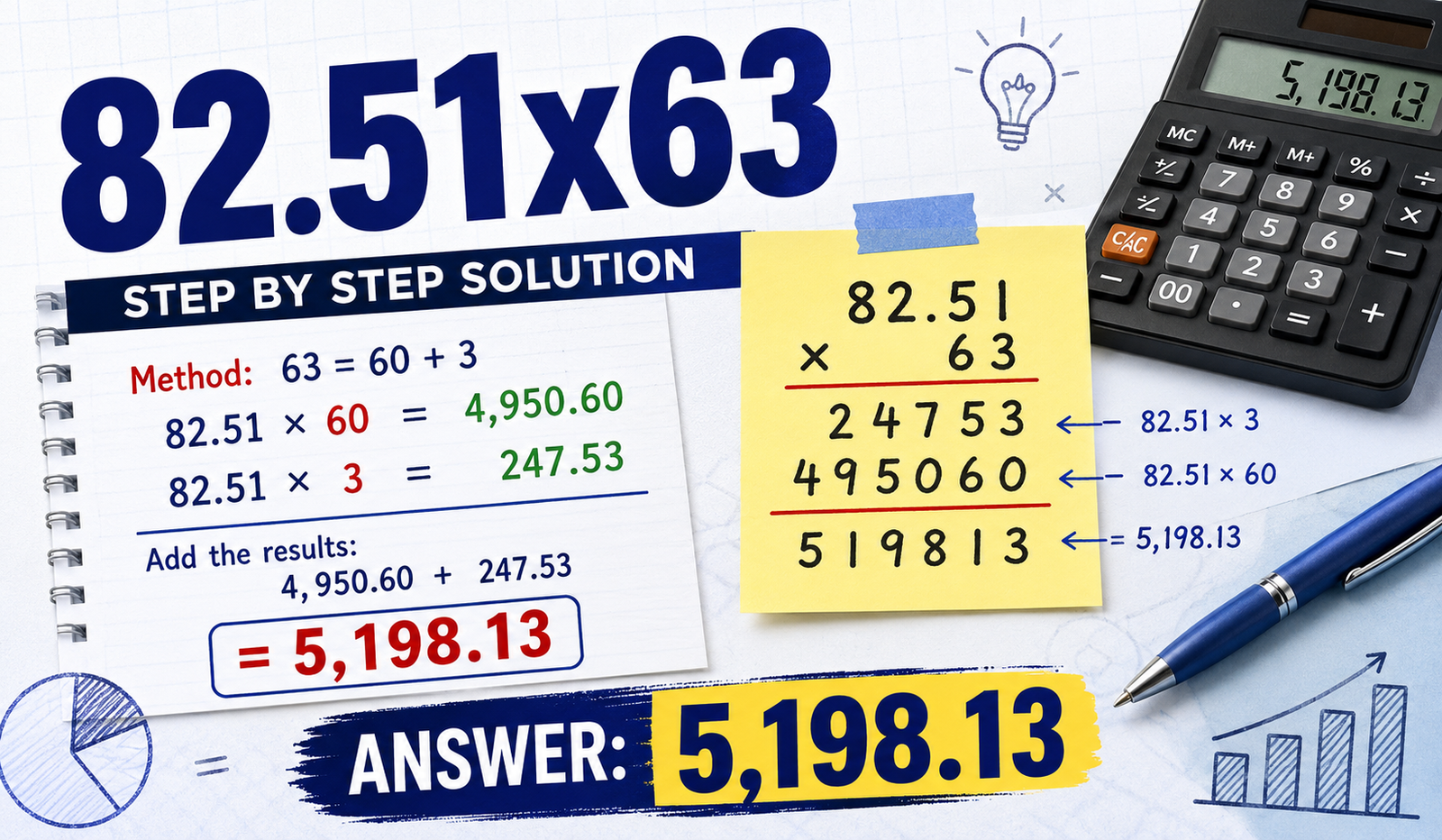
One of the easiest ways to solve the problem mentally is to split 63 into 60 + 3. This works because 63 can be represented as the sum of these two simpler numbers. You can then calculate 82.51 × 60 and 82.51 × 3 separately before adding the results. This approach is often easier to understand than immediately using long multiplication because each part has a clear purpose.
Step 3: Multiply 82.51 by 60
First calculate 82.51 × 60. Since 60 is 6 multiplied by 10, begin with 82.51 × 6. The result is 495.06. Now multiply that result by 10, which gives 4,950.60. Therefore, 82.51 × 60 equals 4,950.60. This is the larger portion of the final calculation because 60 represents most of the original multiplier.
Step 4: Multiply 82.51 by 3
Next calculate 82.51 × 3. Multiplying 82.51 by 3 gives 247.53. This part represents the remaining 3 in the number 63. The calculation is relatively simple because each digit of 82.51 is effectively tripled while keeping the decimal position correct.
Step 5: Add the Two Results
Now add the two partial answers together. You have 4,950.60 from multiplying 82.51 by 60 and 247.53 from multiplying 82.51 by 3. Adding them gives 5,198.13. Therefore, the complete calculation is 82.51 × 63 = 5,198.13. This method is useful because it makes every part of the calculation visible instead of treating the multiplication as one large operation.
Step 6: Understand the Decimal Point
The decimal point deserves special attention. The number 82.51 has two digits after the decimal point: 5 and 1. If you temporarily treat 82.51 as 8251, you have effectively multiplied the original number by 100. After performing the whole-number multiplication, you must account for that factor of 100 by moving the decimal point two places to the left. This is why the final answer is 5,198.13 rather than 519,813. Correct decimal placement is one of the most important parts of solving this type of problem.
Solving 82.51 × 63 Using Long Multiplication
You can also solve 82.51 × 63 using the traditional long multiplication method. First ignore the decimal point temporarily and treat 82.51 as 8251. Multiply 8251 by 63. Multiplying 8251 by 3 gives 24,753, while multiplying 8251 by 60 gives 495,060. Adding these two values produces 519,813. Because the original number had two decimal places, move the decimal point two positions from the right. The result becomes 5,198.13. This method is particularly useful when you are working through a written math problem and want to show every calculation.
A Quick Mental Math Method
For a quicker calculation, you can estimate the answer before doing the exact math. Since 82.51 is close to 82.5 and 63 is close to 60, multiplying those approximate values gives a result somewhere around 4,950. The exact answer, 5,198.13, is reasonably close to that estimate. This quick check does not replace the exact calculation, but it can help you notice major errors. If your calculator suddenly shows 519.813 or 51,981.30, for example, the estimate tells you immediately that something went wrong.
Another Way to Verify the Answer
A useful verification method is to reverse the operation by dividing the final answer by 63. If 5,198.13 ÷ 63 gives 82.51, the multiplication has been confirmed. Division is the inverse of multiplication, so this provides a reliable mathematical check. You can also multiply 5,198.13 by the reciprocal of 63, although ordinary division is usually more practical for a simple calculation like this.
Why 82.51 × 63 Equals 5,198.13
The result makes sense because 82.51 is being multiplied more than sixty times. Multiplying 82.51 by 60 already produces 4,950.60. Adding another three groups of 82.51 adds 247.53 to that amount. Once those two quantities are combined, the total becomes 5,198.13. Looking at the calculation this way makes the answer easier to understand rather than simply memorizing the final number.
Common Mistakes When Solving 82.51×63
One common mistake is forgetting that 82.51 contains two decimal places. Another is placing the partial product in the wrong column when using long multiplication. Some people also multiply by 63 as though it were 6.3, which produces a completely different answer. A final common error is adding the partial products incorrectly. The easiest way to avoid these problems is to write each step clearly, keep the decimal position in mind, and perform a quick estimate before accepting the final result.
How to Check Decimal Placement
A simple decimal check can save you from an incorrect answer. Because 82.51 is slightly greater than 80 and 63 is greater than 60, the answer should be greater than 4,800. It should also be around 5,000 rather than hundreds or tens of thousands. The result 5,198.13 fits that expectation. This kind of estimation is especially useful when using handwritten calculations because it can reveal misplaced decimal points immediately.
82.51 × 63 in Expanded Form
Another useful way to understand the calculation is through expanded form. The number 82.51 can be viewed as 80 + 2 + 0.5 + 0.01. Multiplying each component by 63 gives 5,040, 126, 31.5, and 0.63 respectively. Adding these values together gives 5,198.13. Although this method takes longer, it shows exactly how every part of the decimal number contributes to the final result.
Why Breaking the Problem Apart Works
Breaking a multiplication problem into smaller pieces is more than a convenient trick. It uses the distributive property of multiplication. In this case, 63 can be written as 60 + 3, so 82.51 × 63 becomes 82.51 × 60 + 82.51 × 3. This mathematical property works for whole numbers, decimals, fractions, and much larger calculations. Once you understand it, many multiplication problems become easier to handle mentally.
Using a Calculator for 82.51 × 63
A calculator can confirm the result quickly. Enter 82.51, press the multiplication button, enter 63, and then press the equals button. The display should show 5198.13. However, understanding the manual method is still valuable. A calculator tells you what the answer is, while knowing the process helps you recognize whether the displayed answer actually makes sense.
Real-World Example of 82.51 × 63
Imagine that a particular item, service, or measurement has a value of 82.51 units and you need to calculate the total for 63 identical units. Multiplying 82.51 by 63 gives a total of 5,198.13 units. If the original figure represents a price, the exact interpretation would depend on the currency and any applicable taxes or fees. If it represents a measurement, the unit would remain part of the final answer. The multiplication itself remains the same.
Why Learning Decimal Multiplication Matters
Decimal multiplication appears in everyday situations more often than many people realize. Shopping totals, construction measurements, fuel consumption, recipes, financial calculations, distances, weights, and percentages can all involve decimals. Learning how to work confidently with numbers such as 82.51 makes these everyday calculations less intimidating. More importantly, understanding the process gives you a way to check calculator results instead of blindly trusting whatever number appears on the screen.
A Simple Formula to Remember
For this particular problem, the easiest formula to remember is 82.51 × 63 = 82.51 × (60 + 3). Then calculate each part: 82.51 × 60 = 4,950.60 and 82.51 × 3 = 247.53. Finally, add them together: 4,950.60 + 247.53 = 5,198.13. This approach is clean, easy to follow, and useful when you want to explain the answer to someone else.
Final Answer
The final answer to 82.51×63 is 5,198.13. The most beginner-friendly method is to split 63 into 60 and 3, multiply 82.51 by each part, and then add the results. The calculation is 82.51 × 60 = 4,950.60, 82.51 × 3 = 247.53, and 4,950.60 + 247.53 = 5,198.13. Once the decimal placement is understood, this type of multiplication becomes quick and predictable.
Conclusion
Solving 82.51×63 is a good example of how a decimal multiplication problem can become simple when you break it into manageable pieces. Instead of trying to handle the entire calculation at once, split 63 into 60 and 3, multiply 82.51 by each number, and add the results. The calculation produces 5,198.13. Whether you are studying basic mathematics, checking a financial figure, working with measurements, or simply trying to confirm a calculation, this method gives you a clear way to reach and verify the correct answer.
Frequently Asked Questions
What is 82.51 × 63?
82.51 × 63 = 5,198.13. You can reach this answer by using long multiplication or by breaking 63 into 60 and 3.
How do you calculate 82.51 × 63?
Start by calculating 82.51 × 60, which equals 4,950.60. Then calculate 82.51 × 3, which equals 247.53. Add both results to get 5,198.13.
Why does the answer have two decimal places?
The number 82.51 contains two digits after the decimal point. When the multiplication is completed, the final result is written with the appropriate decimal position, producing 5,198.13.
Can I solve 82.51 × 63 without a calculator?
Yes. The easiest manual method is to split 63 into 60 + 3. This gives two smaller calculations that are easy to complete and combine.
What is 82.51 multiplied by 60?
82.51 × 60 = 4,950.60. You can calculate 82.51 × 6 = 495.06 and then multiply by 10.
What is 82.51 multiplied by 3?
82.51 × 3 = 247.53. This is the smaller partial product used when breaking 63 into 60 + 3.
How can I check whether 5,198.13 is correct?
You can divide 5,198.13 by 63. The result should be 82.51. You can also estimate the multiplication first; because 82.51 is around 82.5 and 63 is around 60, a result near 5,000 is reasonable.
Read also: Type of FG964F-D Features, Foam Mattress Design & Uses