









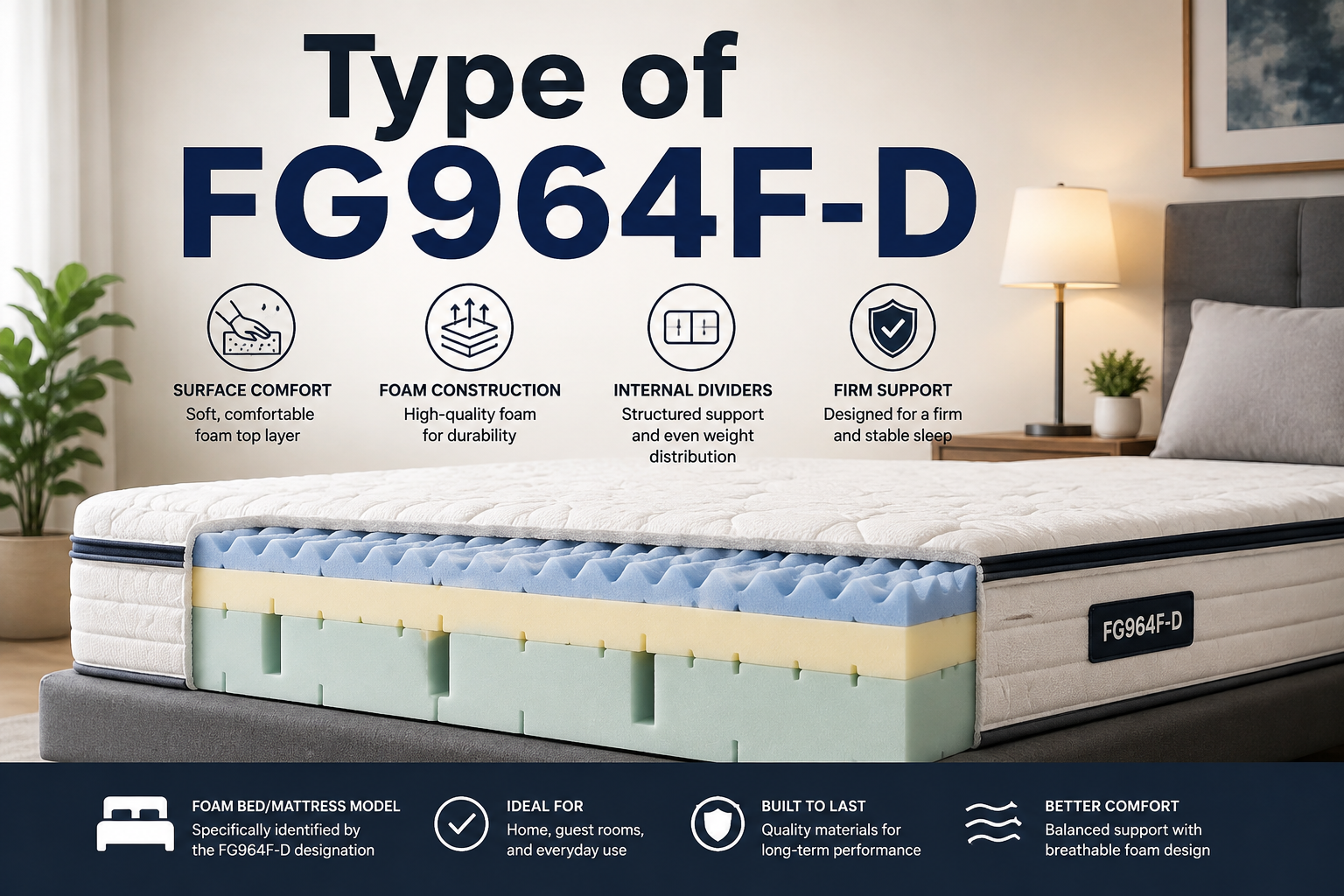
The type of fg964f-d refers to a specific foam bed or mattress model identified by the FG964F-D designation. When people come across a code like this on a mattress label, product listing, or furniture document, it is natural to wonder what it actually means. Is it simply a model number, or does it describe the type of foam, firmness, or construction used inside the bed? In this case, FG964F-D can be understood as an identifier connected with a foam-based mattress design. Understanding the type of material and construction behind a mattress can make it much easier to judge whether it is suitable for sleeping, guest-room use, temporary accommodation, or another purpose. Rather than focusing only on the code itself, it helps to look at what a foam mattress is designed to do, how its internal structure affects comfort, and what information should be checked before purchasing or replacing one.
What Is the Type of FG964F-D?
The type of FG964F-D is best described as a foam bed or mattress model identified by the FG964F-D designation. The code itself does not automatically tell you every technical specification, such as the exact foam density, thickness, manufacturer, or firmness rating. Those details normally need to come from the product label or manufacturer documentation. However, its association with a foam mattress means the most useful way to understand it is by looking at foam construction and the role that different layers can play in overall comfort. A foam bed generally relies on one or more layers of resilient material rather than traditional metal springs as its primary support system. Depending on the design, the foam can provide cushioning, pressure distribution, and support while adapting to the sleeper’s body. This makes identifying the actual construction particularly important when trying to understand an FG964F-D mattress.
Why Mattress Identification Codes Matter
Mattress identification codes can seem confusing at first, especially when they consist of a combination of letters and numbers. However, these codes are often useful because they distinguish one product or configuration from another. A code such as FG964F-D may appear on a label alongside information about dimensions, materials, manufacturing details, or compliance information. The code alone should not be treated as a complete technical description. For someone researching the mattress, the best approach is to record the entire label rather than focusing on one identifier. This can reveal information that the model code does not provide by itself. It is also helpful when looking for a replacement mattress or trying to match an existing bed with a compatible product.
Foam Construction Explained
Foam mattresses can be built in several different ways, and this construction has a direct effect on how the mattress feels. Some designs use a single foam layer, while others combine multiple layers with different properties. One layer may provide softer cushioning, while another provides firmer support underneath. Some foam products can also contain internal sections or dividers that separate different areas of the mattress. These internal features may influence how the material responds when weight is placed on different parts of the surface. For that reason, describing FG964F-D simply as “foam” may not tell the whole story. The important questions are what type of foam is present, how thick each layer is, how dense the material is, and how the layers work together.
Surface Comfort and Touch
One of the first things people notice about a foam mattress is the feel of its sleeping surface. The top layer can determine whether the bed feels soft, firm, springy, or relatively dense when someone lies down. A surface-touch foam design may provide an immediate cushioning sensation while still relying on deeper layers for support. This distinction matters because surface comfort and overall mattress firmness are not always the same thing. A mattress can feel comfortable and slightly cushioned at first while still providing relatively firm support underneath. When evaluating the type of FG964F-D, paying attention to both the surface feel and deeper support structure gives a more realistic understanding of how the mattress may perform.
Firmness and Sleeping Support
Firmness is another important consideration when examining a foam bed. A firm mattress generally resists compression more strongly, while a softer mattress allows the body to sink further into the surface. Foam construction can create different combinations of these sensations. For example, a mattress may have a softer upper layer over a firmer supporting layer. This arrangement can provide cushioning without making the entire bed feel soft. The exact firmness of an FG964F-D model should not be assumed solely from the identifier, however. If firmness is important for a purchase or replacement decision, the manufacturer’s specifications, product documentation, or physical testing are better sources of information.
Internal Dividers and Mattress Structure
Internal dividers can be an important part of some foam mattress designs. These sections may help separate areas of material or create a particular internal structure. The purpose and arrangement of such dividers can vary considerably between products, so it would be inaccurate to assume that every FG964F-D mattress uses the same internal configuration without supporting documentation. Still, understanding the idea helps explain why two mattresses that both use foam can feel noticeably different. Internal construction influences how weight moves through the mattress, how the material compresses, and how quickly the surface returns to its original shape after pressure is removed.
How Foam Mattresses Differ From Spring Mattresses
A foam mattress differs from a conventional innerspring mattress mainly in the way it provides support and responds to pressure. Traditional spring mattresses use metal coils as a major part of their support system, while foam mattresses rely primarily on flexible foam materials. This can create a different sleeping experience. Foam generally provides a more continuous surface, whereas spring systems may produce a more responsive or bouncy feel. Neither construction is automatically better for everyone. Personal preference, sleeping position, body weight, room temperature, budget, and the mattress’s actual specifications all matter. If FG964F-D is being considered as a replacement for a spring mattress, comparing these construction differences can help set realistic expectations.
Who Might Consider a Foam Bed?
A foam mattress can appeal to people who prefer a stable sleeping surface and a less traditional feel than a coil mattress. It may also be useful in guest bedrooms, temporary living spaces, dormitories, furnished properties, or ordinary bedrooms where a foam construction is preferred. However, suitability depends on the exact model. A person’s preferred firmness and sleeping position can make a significant difference. Someone who likes a firm sleeping surface may appreciate a denser foam construction, while another person may prefer a softer upper layer. The important point is that the FG964F-D identifier should be used as a starting point for research rather than as a substitute for complete product specifications.
What to Check on an FG964F-D Label
If you have an FG964F-D mattress in front of you, examine the complete label carefully. Look for the manufacturer or brand name, mattress dimensions, material information, production details, model number, and any other identifying information. The label may provide clues that are impossible to determine from the FG964F-D code alone. If the mattress has been used for several years, the label may also be helpful when trying to identify the original product. Taking a clear photograph of the entire label can make later research much easier. This is especially useful when contacting a retailer, manufacturer, or replacement-parts supplier.
Mattress Size and Compatibility
Before purchasing a replacement for an FG964F-D mattress, confirm the physical dimensions rather than relying only on the model name. Mattresses that look similar can have different lengths, widths, or thicknesses. Even a small size difference can create problems when the mattress is placed inside a bed frame. Measure the existing mattress and the available frame space if possible. Also check whether the bed requires a specific mattress thickness or support base. Correct sizing is particularly important when replacing a discontinued or older model because product names and codes can change over time.
Foam Density and Why It Matters
Foam density is an important technical detail because it can influence durability, support, and the overall feel of a mattress. Density and firmness are related concepts, but they are not identical. A high-density foam is not automatically the firmest foam, and a low-density foam is not necessarily the softest. Different formulations can behave differently even when their densities are similar. Therefore, if you need detailed information about the FG964F-D model, finding its documented foam density would be much more useful than trying to decode the letters and numbers in the model identifier.
Durability of Foam Mattresses
The lifespan of a foam mattress depends on several factors, including material quality, construction, usage, body weight, sleeping habits, and maintenance. Over time, foam can lose some of its original resilience. Regular use can create impressions in areas where pressure is concentrated, particularly if the material is not designed for heavy or continuous use. A well-maintained mattress may perform better for longer, but no foam product should be expected to remain identical forever. If an older FG964F-D mattress has developed significant sagging, unevenness, damage, or changes in comfort, those physical signs are more meaningful than the model code when deciding whether replacement is necessary.
Cleaning and Care
Proper care can help maintain a foam mattress in better condition. The mattress should be kept dry and protected from unnecessary moisture. If the cover is removable and washable, follow its care instructions instead of assuming it can be cleaned using any method. Avoid soaking foam unless the manufacturer specifically permits it, because trapped moisture can take a long time to evaporate. A suitable mattress protector can also help protect the surface from spills, dust, and everyday wear. For an FG964F-D model, the safest approach is to follow the care instructions supplied with the specific product whenever they are available.
Is FG964F-D a Standard Mattress Type?
FG964F-D should not automatically be treated as a universal mattress category such as memory foam, latex, innerspring, or hybrid. It is more accurately understood as a specific identifier or model designation associated with a foam bed or mattress. The distinction matters because model numbers are created by individual manufacturers or product systems, whereas mattress categories describe broader construction types. Without manufacturer documentation, it would be difficult to determine exactly what every part of the FG964F-D code represents. This is why anyone researching the product should avoid assuming that the letters and numbers themselves reveal the complete material composition.
How to Research an FG964F-D Mattress
The most reliable way to research an FG964F-D mattress is to begin with the complete product label. Write down every visible detail, including the model number, brand, dimensions, material descriptions, and manufacturing information. Next, compare those details with product documentation or information from the original seller. If the mattress is older, archived product information may sometimes be more useful than modern listings. A photograph of the label can also help when asking a retailer or manufacturer for identification. This approach is more dependable than relying on a model code alone.
Common Mistakes When Identifying Mattress Models
One common mistake is assuming that a model number is the same as a material specification. It is not. Another mistake is using a similar-looking code from a different product as proof that the mattresses are identical. Even a single letter or number can represent a different configuration. People also sometimes assume that the word “foam” tells them whether a mattress contains memory foam, polyurethane foam, or another material. It does not necessarily provide that level of detail. Careful identification requires the full label and, ideally, documentation from the manufacturer or seller.
Is the FG964F-D Suitable for Everyday Sleeping?
Whether the FG964F-D is suitable for everyday sleeping depends on its intended design, condition, dimensions, support characteristics, and material specifications. If it was manufactured as a regular sleeping mattress and remains in good condition, it may be suitable for normal use. However, a product code alone cannot establish its suitability. A mattress intended for specialized furniture, temporary use, institutional settings, or another purpose may have different requirements. Checking the original product documentation is therefore the safest way to determine its intended application.
Why the Exact Specifications Matter
When people search for the type of FG964F-D, they are often looking for a simple answer. The reality is that a model identifier only becomes truly useful when it is connected to verified specifications. Foam type, density, thickness, firmness, dimensions, cover material, intended use, and manufacturing information all help build a complete picture. This is especially important if someone wants to buy a replacement, compare prices, evaluate an older mattress, or determine whether an existing bed is appropriate for everyday use. Instead of guessing from the code, use the code to locate the information that actually matters.
Conclusion
The type of FG964F-D can be understood as a specific foam bed or mattress model identified by the FG964F-D designation. Its foam-based construction makes factors such as surface comfort, firmness, internal structure, density, thickness, and durability important when evaluating the product. At the same time, the identifier should not be treated as a complete technical specification. If you own an FG964F-D mattress and want an exact identification, the complete label is the best starting point. A clear image of the label can reveal information that the model code alone cannot provide. In the end, understanding the actual materials and construction is far more useful than simply knowing the name of the model. That approach gives you a better basis for judging comfort, compatibility, maintenance, and whether the mattress is the right choice for your needs.
FAQs About the Type of FG964F-D
1. What is the type of FG964F-D?
The type of FG964F-D refers to a specific foam bed or mattress model identified by the FG964F-D designation. The code itself does not necessarily provide every technical specification about the mattress.
2. Is FG964F-D a foam mattress?
FG964F-D is described as a foam-based bed or mattress model. However, the exact foam material, density, thickness, and layer arrangement should be confirmed through the product label or manufacturer documentation.
3. Does FG964F-D describe mattress firmness?
Not necessarily. The FG964F-D designation is primarily an identifier. The actual firmness should be confirmed through product specifications or by evaluating the physical mattress.
4. Can FG964F-D have internal dividers?
A foam mattress associated with this designation may feature internal sections or dividers depending on its specific construction. The exact arrangement should be confirmed from the product documentation.
5. How can I identify my FG964F-D mattress?
Start by checking the complete mattress label. Look for the brand, model number, dimensions, material information, and manufacturing details. A photograph of the entire label can also make identification easier.
Read also: sportnewsplanet .com Sports News, Analysis & Updates